Showing posts with label effective change. Show all posts

Friday, January 20, 2012

Change Is Personal!

Let's face it! Change is personal. Yet, we often hear that we should divorce emotions from business. It sounds something like this... "Leave the personal stuff at the door" or "Leave the emotion out of it" or "Let's focus on the facts, not the individual" or some other statement like that.

But people are not machines. Research has shown that unlike Descartes suggested, emotion does drive behavior and decisions (A. Damasio, A. Bechara, L. Sayegh). This is evident in financial market fluctuations. Markets don't react. People (investors, traders, etc.) react. People make emotional and irrationally decisions. Most of our purchases are biased by our emotions (ask a professional sales person!).

So, when it comes to change, people also react based on emotions. It is part of being a human. Why? There are at least two reasons. First, organizational change often threatens (at least in perception) what people hold dear to them such as their...
  • Status in the organization
  • Ability to influence others
  • Level of contribution
  • Routine and habits
  • Career progression
  • Pay and ability to maintain a life style
  • Job security
All of these interfere with a person's comfort and safety. And that's personal!

A second reason is that change requires people to make choices. Should I support this change? How do I cope best? How do I tell so and so? Should I voice my concerns or suck it up? Should I wait it out or leave while I can? These are only some of the decisions facing someone who is undergoing significant change. People consider the facts of course, but in the end, it's what's in their hearts that will drive them to action. And that's personal!

During time of change, it is critically important to understand people and why they react the way they do. For instance, so called "resistance to change" is fundamentally a personal emotional response, not a cognitive reaction. Yet, resistance is often addressed by traditional business communication (one way, fact-based, top down), which most often ignores the root cause of the resistance but is seen as a panacea for organizational change.

So, if you think you should you leave the emotions out of organizational change, think again. Because when it comes to change, it's personal. And ignoring that, doesn't' make it go away. It only gets more personal. Just ask Reed Hastings!

p.s. ok, he did come to his senses, just a bit late.

Photo by Ambro

Thursday, October 20, 2011

What's Wrong with Stakeholder Analysis?

Recent work with a client reminded me of something I wanted to share with others. Many years ago when I started giving change management seminars, I noticed a pattern that I did not like. When we covered the concept of stakeholder analysis, inevitably someone (usually more than one) would express concern, even fear about using this most commonly used tool. Their concerns?
  • What if someone sees the document?
  • What if so and so found out we labeled them as "not supportive"?
  • How do we even know for sure they aren't supportive?
  • Why would you NOT want anyone to be 'strongly supportive' anyway?
You see, traditional stakeholder analysis (see example below), a key staple in change management, works like this: The group makes a list of stakeholders. They then agree on the current vs. the desired level of support of each stakeholder using either a numbered scale or a labeled scale. Labels can vary from quite benign such as 'supportive' to 'non-supportive', to quite pejorative such as 'laggards' or 'resistors.' What's worse, often these evaluations are based on hear-say and group think. So, my students had a point!
And we'd usually spend several minutes of class time addressing the concerns for which I really didn't have a good answer. After a while, I tired of trying to defend the tool, so I abandoned the traditional stakeholder analysis tool for good and developed a different, more useful (I think) approach. Instead of labeling, I wanted to empathize. Instead of analyzing, I wanted to understand. I wanted to empathize with the stakeholder and understand why they would or would not support the change effort.

The approach? Have a conversation with them or with someone who really understands them. The questions?
  1. IMPACT: How will they be affected or impacted? How is the stakeholder involved in the change effort? What will they need to do differently?
  2. BENEFIT: What will be a gain or benefit to the stakeholder? What would they consider a real win?
  3. CONCERN: What concerns might the stakeholder have about the change? What would they consider a losing proposition? What issues do they see related to the change?
There is more to stakeholder work than this, but the key concept is this:

Maximize the benefits + Minimize the concerns = Support

That's it! No fancy Os and Xs, no psychoanalysis, no labels, no risk. Just plain old fashion communication that gets to the real reasons for why stakeholders decide to support or not support the change. Sure, it may not look as nice as an Os and Xs chart. However, this approach has several benefits:
  1. It provides much more and richer information through real discussion.
  2. It uncovers and challenges assumptions.
  3. It is non-judgmental, no need to label people.
  4. Best of all, after the dialogue, you'll have a very good idea about how to influence someone who might not be excited about the change.
Give it a try next time you need to influence people to 'buy into' a change that is not their idea. You might be surprised how well it works. I'd love to hear your comments and your experience.

Friday, June 10, 2011

Lessons from Long Distance Running: Milestones

This is part of the series "Lessons from Change Management Strategies and Long Distance Running."

Any journey begins with one step!
As the saying goes, you eat an elephant one bite at a time. The same is true of a long distance race. At least for me! Sixteen miles to run can be an overwhelming thought, discouraging, even depressing to some! The night before the race I drove through the course to familiarize myself with the course, the turns, the hills, some key landmarks. Mentally I broke down the course into manageable pieces or segments.

From the map I knew where the mid-point was. The course also had markers every mile. My mental "milestones" were at mile 3, 7, 10, 13, and the finish line. Past mile 7 it was all about running 3 more miles. A 3-mile run (5K) is manageable, I knew I could do that much. I just needed to do that three times. But my focus was only on the segment I was on, which I knew I could finish. I'd worry about the next segment in time. Throughout the race there was support stations with water, oranges, energy gels, and first aid help for those who needed it. Best of all, there were plenty of people rooting for and celebrating the runners.

Implementing a large change initiative can be daunting. In fact, it is the overwhelming nature of the beast that often causes the initial challenges such as disbelief, lack of confidence, the 'this too shall pass' syndrome, and other reactions that threaten success. Borrowing lessons from a long distance run, here are five ways to make organizational change more manageable through milestones:
  1. Define a roadmap: Establish a well defined end point and roadmap to get there. Involving key people in the process helps. Sharing it broadly and inviting discovery helps make the roadmap 'theirs.'
  2. Chunk it up: Break the roadmap down into manageable pieces with a defined outcome people can recognize. Examples might include: announcement of proposed solution(s), data collection and analysis, pilot phase, rollout in location A, etc.
  3. Know the way: Familiarize the organization with what the path might look like, what they can expect to see, both good news and bad news. Plan and equip people with ways to deal with roadblocks, slowdowns, detours, and other challenges.
  4. Focus on the now: We'll explore this one point further in a separate post but if leaders get onto other 'priorities' hoping the troops will continue the work, they might find that the troops followed suite and they also take their eyes off the current body of work.
  5. Celebrate: mark each milestone and associated accomplishment with a genuine cause for celebration. This gives people a sense of closure, helps them recognize progress, and provides energy for the next phase.
Milestones require early and careful planning. They can provide focus, direction, and are one way to create energy to fuel the change work. Milestones made it possible for me to complete something that initially seemed impossible because of my knee problem. Likewise, with the right planning and roadmap, large and complex organizational change can be a productive transition that achieves the desired results, even if it means one bite at a time.

Photo by Dan.

Friday, May 20, 2011

Change Management Strategies & Long Distance Running

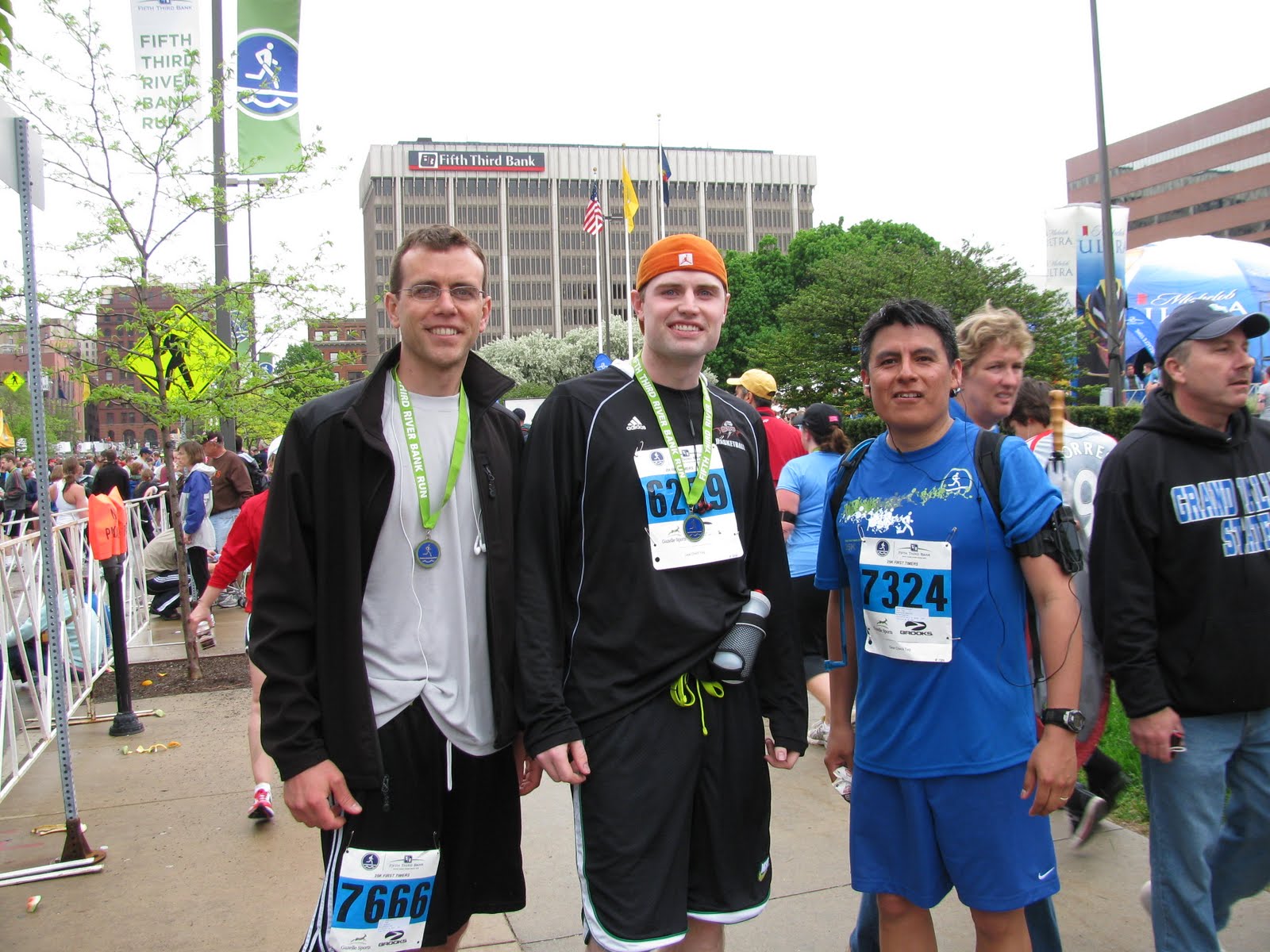
With two good friends after the race
I recently completed my first 25K race (15.8 mi), which was quite the experience! Though I'm glad I did it, the race was long and difficult. Of the thousands who started, many runners did not finish. Some got injured; others simply gave up. I even saw an ambulance...not an encouraging sight!


So, what does this have to do with Change Management strategies?

As I trained for several months, I thought of some similarities or lessons about long distance running and embarking in a large organizational change initiative, particularly those aimed at culture change. I’ll explore these lessons in separate posts over the next several weeks.

These lessons are not meant to describe all there is to running or to describe all in effective change management. They are only intended to highlight individual aspects of complex organizational change that leaders and change agents should consider as they embark on such a transition.
  1. Preparation—probably the most important aspect but often shortchanged for the sake of expediency.
  2. Commitment—successful completion requires doing, not just talking about it.
  3. Flexibility—flexibility is critical to endurance and managing pain and the urge to stop.
  4. Milestones—breaking the effort into phases with specific milestones can make the process much more manageable.
  5. Focus—managing competing priorities and initiatives can help maintain the necessary focus, particularly over a long transition.
  6. Energyrequired not only to start but also to continue, complete, and sustain the effort.
  7. Pace—burning yourself out too soon can make the difference between failure and finishing.
  8. Pain—managing pain is a critical component to a successful completion AND to a healthy recovery.
  9. Support mechanisms—important to sustainability and ultimately completion.
There is more to both endurance running and organizational change management. I will focus and elaborate on these similarities over the next few posts.


Stay tuned...